
Admission season is one of the most stressful periods in a school's calendar. Walk-in inquiries, phone calls, WhatsApp messages, paper forms, manual roll number assignments, TC verification — all happening simultaneously, often managed by one or two people. A digital admission management system doesn't just digitize the paper; it transforms how the entire process flows.
The Admission Pipeline: Inquiry to Enrolled
A well-designed school admission system tracks every prospective student through a defined pipeline: Inquiry → Applied → Confirmed → Enrolled. At each stage, the right information is captured and the right person is notified. Walk-in inquiries, phone inquiries, and online inquiries all enter the same pipeline — so nothing falls through the cracks and every lead can be followed up systematically.
What Indian Schools Need in an Admission Form
Indian schools have specific data requirements that generic software misses. Beyond the standard name, date of birth, and contact information, Indian K-12 admission forms need: Aadhar Number, Nationality, Religion, Caste Category (General/OBC/SC/ST), mother tongue, and parent occupation. These fields are required by Indian school boards and are used in government reporting. A school ERP built for India should have all of these pre-built — not as an add-on.
Automatic Admission Numbers and Roll Numbers
In most schools, admission numbers are assigned manually — someone checks the last number used and increments it. This creates gaps, duplicates, and confusion when two admissions happen simultaneously. A school management system auto-generates admission numbers in a standardised format (e.g., ADM-2026-0001) and assigns roll numbers automatically based on the class and section the student is placed in. No manual tracking. No errors.
TC Validation: The Step Most Software Misses
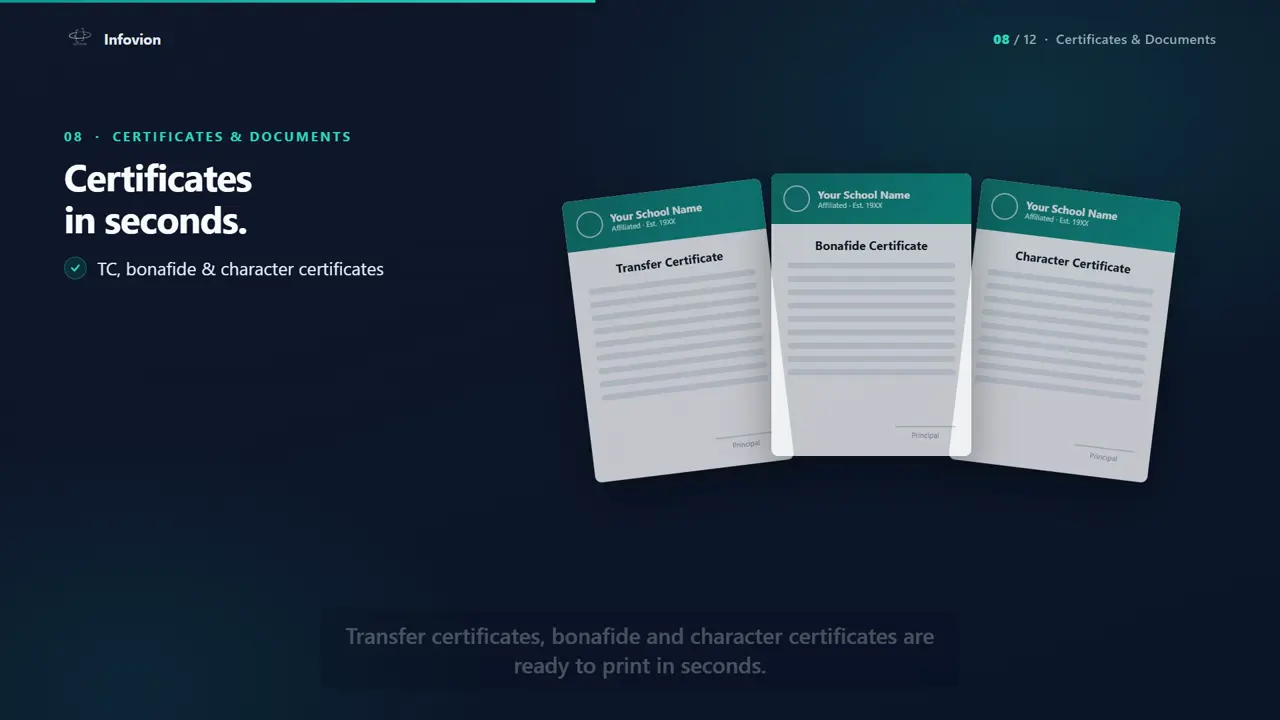
The Transfer Certificate requirement is uniquely Indian. Students transferring from another school must present their TC before enrollment can be completed — except for Class 1 admissions, where TC is not applicable. Most generic school software either ignores this entirely or makes it optional. A school ERP built for Indian boards enforces TC capture for Class 2 and above as a mandatory step in the admission flow — making compliance automatic, not something the admissions officer has to remember.
From Inquiry to Class: What the Process Looks Like in a School ERP
Here's a typical admission flow in a digital system: A parent walks in and expresses interest. The receptionist logs an inquiry — capturing the parent's contact, the child's name, and the desired class. The inquiry is assigned a status and a follow-up date. When the parent returns with documents, the inquiry is converted to an application — the full admission form is completed. Once documents are verified and a seat is confirmed, the student is enrolled: admission number auto-generated, roll number assigned, class and section set. The student record is now live and accessible across all modules — attendance, fees, exams, timetable.
The Result: Admission Season Without the Chaos
Schools that move to digital admission management report the same outcomes: fewer missed follow-ups (every inquiry is tracked), faster enrollment (no manual number assignment or form re-entry), cleaner records (all required fields are enforced), and better visibility for the director (live count of inquiries, applications, and enrollments at any point in the admission season). It doesn't make admission season stress-free — but it makes the stress manageable.